Views on the Genealogy and Lineage of the Fujiwara Clan
Introduction
In recent years, we have observed cases where some individuals, including public figures, claim to be "descendants of the Fujiwara clan" without presenting clear historical evidence (in essence, genealogies forged or embellished during the Edo period).Such unfounded claims are seen to be used for various purposes, including legitimizing authority, enhancing social standing, exercising influence, and promoting businesses or corporate images.
As the Hashimoto family, connected to the historical lineage of the Fujiwara clan, we wish to state our position on this situation and share our fundamental perspective on discussing genealogies.
About the Hashimoto Family
Primary sources (originals) confirmed at holding institutions — National Diet Library / Nara Prefectural Library and Information Center (confirmation date: November 8, 2025). Go to sources & verification notes
The Hashimoto family is a lineage associated with the Ichijōin monzeki (based on the 1874 petition for stipend return and family registers, it is clear they were samurai class from the Ichijōin estate). Their home base was Hossōin-no-shō (Hashinoin-shō, with roles such as Tayū and Kobettō) within the Ichijōin estate. During the Meiji period, it has been confirmed that the stipend of Hashimoto Heisaku of the Hashimoto family constituted about 1% of the total income (approx. 1492 koku) of the Ichijōin estate (he held concurrent positions as middle-ranking monk, official, and elder, and was the only samurai-class family in Hossōin; see sources below).
Jikken (see source), from the Takatsukasa family, held the name "Hashimoto," and Ryōshin (see source) held the name "Gohosshin'in." Additionally, Ryūun of the Asukai family used Hashimoto as his original surname. This suggests that during the Muromachi period, a close relative or an illegitimate child of the monzeki settled in the Hossōin area and took the name Hashimoto.
At the end of the Edo period, Fujikazu, an adopted son of the Hashimoto family (from the Nikaidō-ryū Fujiwara clan [Chūjō family]), became a loyalist and was imprisoned. He was pardoned through the intercession of the Asukai family, a branch of the Fujiwara Hokke Kasannoin-ryū Nanba family, which belonged to the court nobility and later the peerage (see item 711, available in the National Diet Library Digital Collections, publisher: Keizai Zasshisha, publication date: November 1912, call number 20-98, bibliographic ID 000000551139, link to the National Diet Library).
Note: Definition of "close relative or illegitimate child" includes blood relations + adopted children.
These historical details can be verified through the historical materials listed in "§5. Table of Evidence Materials" (all materials have been physically confirmed by National Diet Library staff).

Download family tree (PDF)
Download family tree (PDF)
● Documents on the perpetual stipend (petition for stipend return) are here →
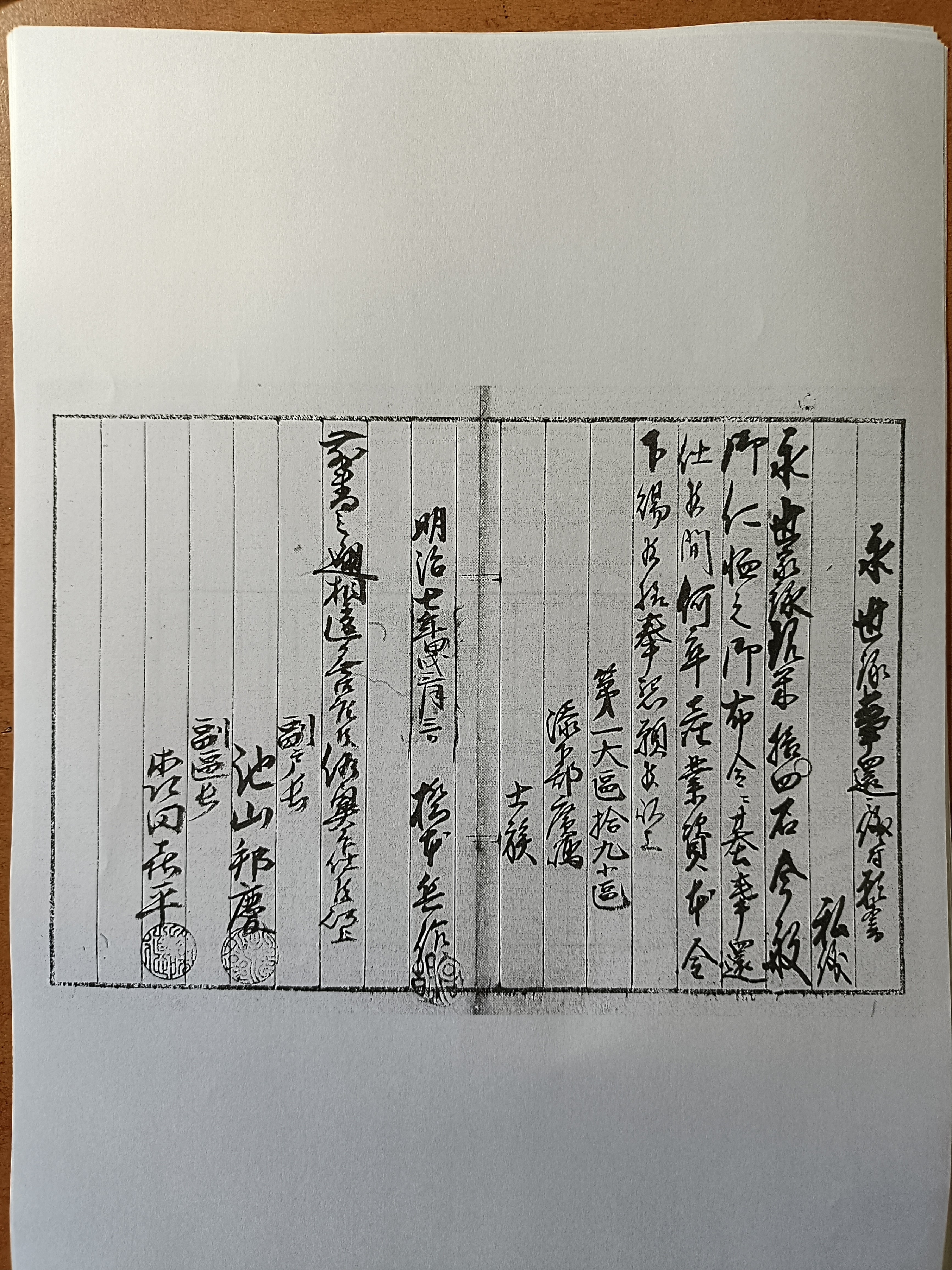 Download PDF
● About the Asukai family and Hashimoto Tōichi →
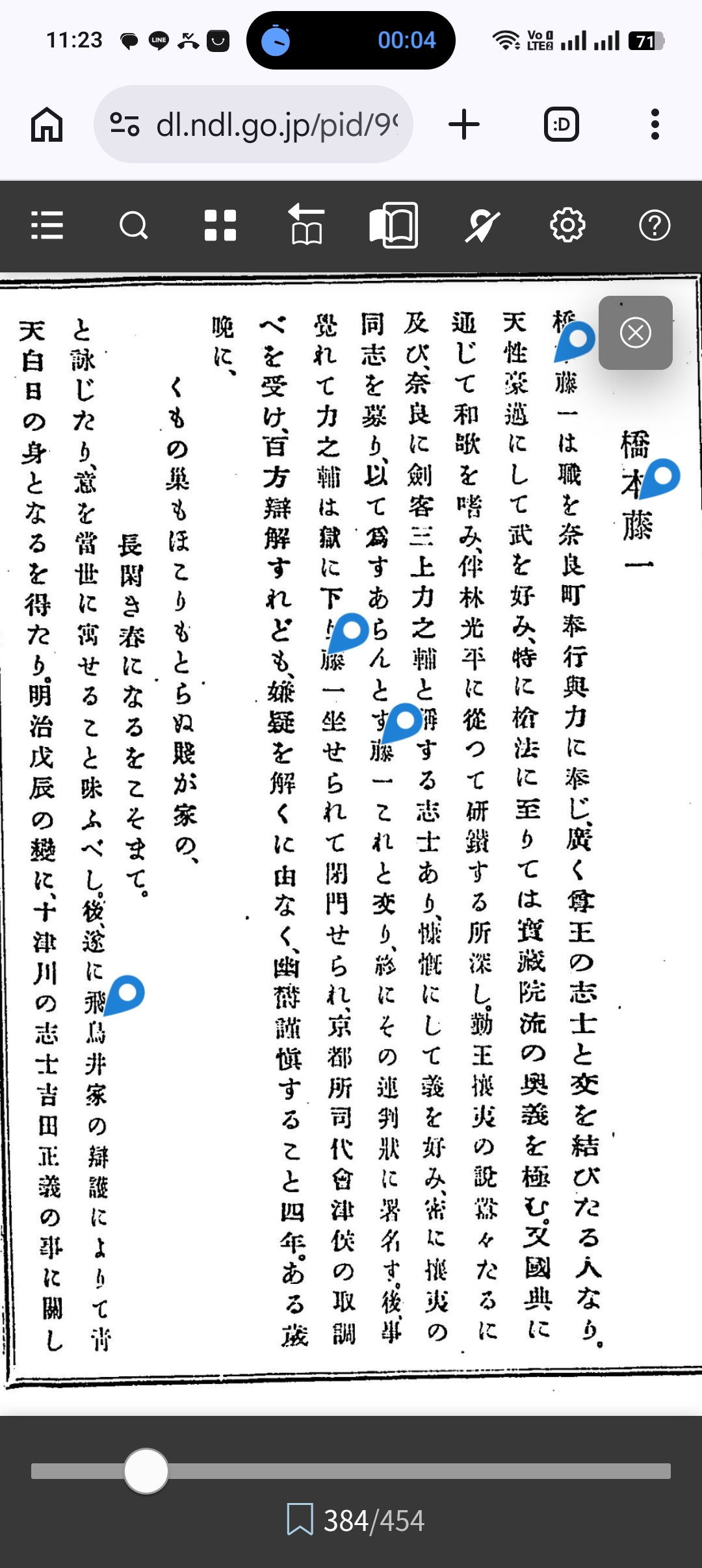
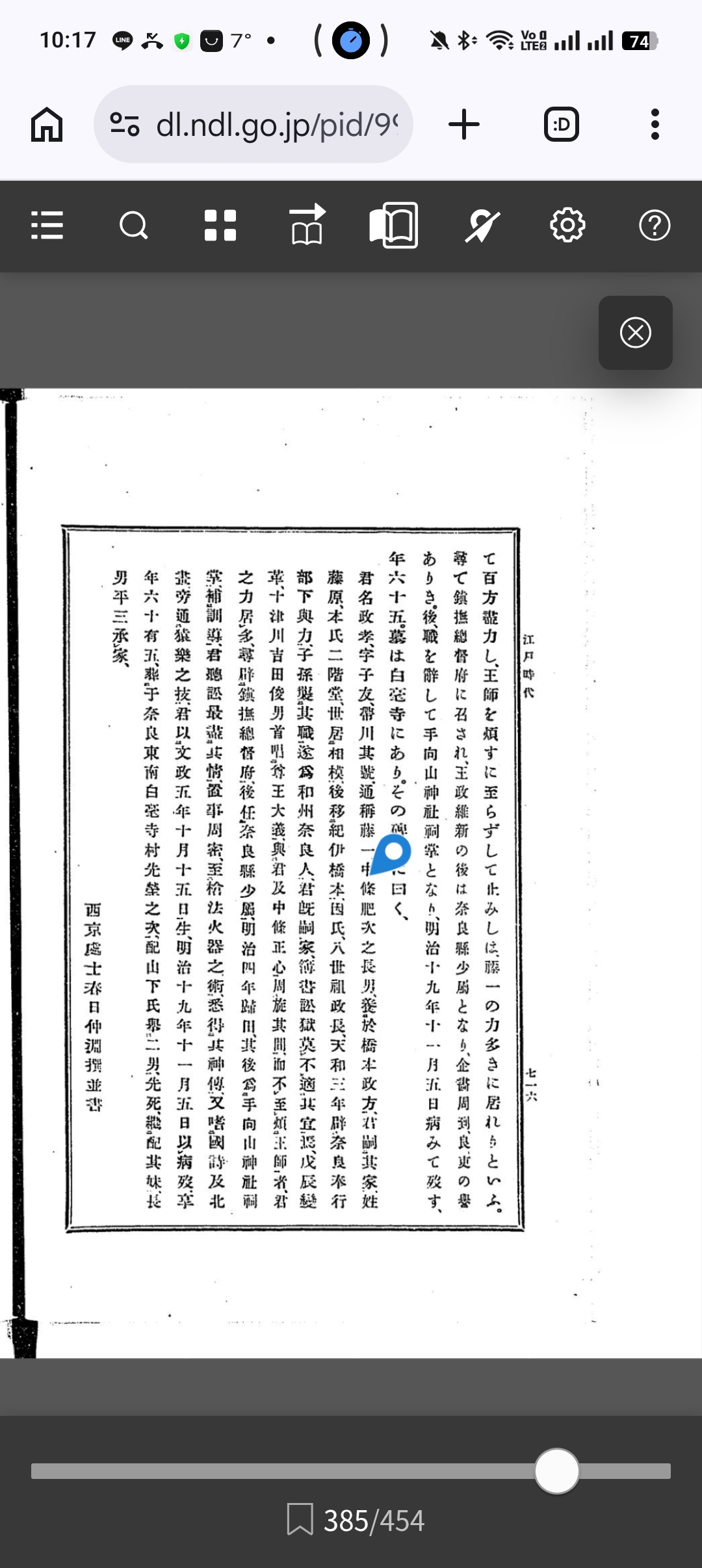
Fundamental Stance on Discussing Genealogies
1. Importance of Verification Based on Historical Sources
When discussing a family lineage, objective historical sources such as the following are required:
- Genealogical documents: Records containing names of successive heads, birth and death dates, official ranks, etc.
- Official records: Court records, temple and shrine records, domain records, etc. (embellishment is unacceptable).
- Documents related to land and property: Land confirmation documents, transfer deeds, etc.
- Gravesites and mortuary tablets: Physical evidence proving existence.
Summary: Academically, additional factors such as "authenticity of sources, period of creation, contemporaneity, independence, philological verification, non-genealogical physical evidence, comparative methods, and quantitative approaches" are considered. These are combined to comprehensively evaluate reliability. Mere "family traditions" or "oral legends" alone cannot historically prove a lineage.
2. Difficulty of Connecting with the Pre-modern Era
Proving that an early modern family is directly linked to a famous clan from the medieval or ancient periods is often difficult. Factors such as the dispersal of records due to wars, restoration after family extinction or adoption, and later embellishment of genealogies complicate verification.
Specific Examples
1. The Critical Meaning of "Lack of Primary Sources"
In genealogies connecting medieval warrior families to early modern wealthy farmers, the period from the end of the Sengoku period to the beginning of the Edo period often represents a significant black box.
- The primary source barrier: When local warrior families were defeated and dispersed during the Sengoku period, how did their descendants transform into early modern village headmen (shōya) class? Unless there are "contemporary primary sources" proving this, historical scholarship deems it "unverifiable."
- Source criticism of genealogies: Genealogies compiled during the Edo or Meiji periods are secondary or tertiary sources, often based on wishes or legends, and thus their evidentiary value is extremely limited.
2. Social Background of "False Claims" and Statistical Probability
During the Edo period, it was very common for influential local figures (village headmen, wealthy farmers) to adopt the surnames of former local warrior families and connect their genealogies.
- Typical pattern: The "noble wandering tale" of being descendants of a Sengoku warlord who returned to agriculture was a widespread custom for strengthening authority within the village.
- Statistical perspective: Under conditions of the same region and same surname, research tends to assign a higher probability to the "cultural phenomenon of surname borrowing and genealogy connection" than to actual blood relations.
3. Modern Success and Academic Evaluation
In many cases, claims are based on traditions passed down within the family or genealogies compiled by the family itself.
- Importance of third-party historical sources: Without contemporary records from unrelated third parties (temples, shrines, government offices), the claim remains at the level of "self-proclamation."
- Selectivity in source preservation: There is a source bias where only favorable traditions are preserved, while contradictory evidence is lost.
4. Concrete Examples
Claude's response
The reliability of the claim that Toshimichi Ōkubo was a descendant of the Fujiwara clan is considered to be around 10-20%.
Basis:
Reasons for many doubts: The Ōkubo family was of lower-ranking samurai status (O-koshō-yo) in Satsuma, and reliable sources tracing their genealogy back to the Fujiwara clan are scarce. In medieval and early modern warrior society, it was common to claim descent from famous nobles (such as the Fujiwara) to elevate family status. For a lower-ranking samurai family from the Satsuma domain, there are almost no contemporary sources demonstrating blood relation to the Fujiwara clan.
Reasons why it's not entirely impossible: Records show the Ōkubo family used the surname "Fujiwara." Theoretically, it is not impossible that a branch of the Fujiwara clan that went to Kyushu in the medieval period became local warriors over time, and their descendants settled in Satsuma. However, proving blood relations spanning hundreds of years is extremely difficult.
Conclusion: While there is a fact that "the family claimed to be descendants of the Fujiwara clan" as a family tradition, historically proving an actual blood connection is very challenging, so reliability must be considered low. Considering that many warrior families claimed descent from prestigious lineages, this claim is likely a "title to indicate family status."
ChatGPT's response Proportion of scholars pointing out "lack of primary sources": While no strict statistics exist, the majority of specialists conducting source criticism on genealogies (approximately 70–90% of specialized papers) highlight the absence of primary sources — this is a realistic estimate.
A Verification Perspective: "The Sustainability of Warrior Status"
The Unnaturalness of "Abandoning Warrior Status" from an Economic Base Perspective
In verifying genealogies from the Edo period, an often overlooked but crucial perspective is the question: "Did the family have the economic base to maintain warrior status?"
Basic Knowledge of Kokudaka and Living Standards
During the Edo period, the annual living expenses for one adult were considered to be about 1 to 1.5 koku. Therefore:
- Samurai with 100 koku → Could support approximately 70 people including family.
- Samurai with several hundred koku → Could maintain a sufficient living standard as upper-ranking samurai.
- Higher stipends → Could retain retainers and stably maintain warrior status until the Meiji Restoration.
Concrete Example of Contradiction
Consider a certain local warrior family as an example. This family claims the following history:
- Sengoku period: Held a considerable amount of land as a local influential lord (kokujin).
- Early Edo period: Received treatment equivalent to middle-ranking samurai as a guest retainer (kyaku) of a daimyo domain.
- Later: Transformed from samurai to merchants/industrialists.
Analysis of Contradictions:
If they indeed received treatment as middle-ranking samurai, that implies:
- Enough resources to support family and retainers.
- A not-low status within the domain.
- An economic foundation to maintain samurai status until the Meiji Restoration.
So why would this family abandon their samurai status?
Typically Plausible Scenarios
Typical patterns for a samurai to lose their status are:
- Attainder (kaieki) → Always leaves a record in domain documents.
- Punishment due to implication → Similarly, official records exist.
- Failure of succession → Extinction due to prohibitions like late-term adoption.
In any case, traces always remain in official domain records (such as feudal tenure registers, genealogical statements).
Problems with This Case
However, for this family:
- No records of attainder have been confirmed.
- Records of punishment are also unclear.
- "When" and "why" they left samurai status are not shown in contemporary primary sources.
- They suddenly appear in historical sources as "merchants/industrialists" at a certain point in the Edo period.
There is usually no rational reason to voluntarily abandon a stable middle-ranking samurai position.
Historically More Plausible Explanation
Applying the "false claim" pattern pointed out by the Hashimoto family, the following scenario is statistically more probable:
- A different family line existed that succeeded as merchants or industrialists in the region during the Edo period.
- After achieving success, they connected their genealogy to the old samurai family of the same surname in the same region.
- By adding the prestige of being "descendants of a Sengoku warlord," they enhanced their social standing.
This was an extremely common phenomenon among wealthy merchants and farmers in the Edo period.
Burden of Proof
To resolve this contradiction, the following sources are essential:
- Domain feudal tenure registers: Whether the family is recorded as a guest or retainer throughout the Edo period.
- Records of attainder/punishment: If they lost samurai status, contemporary records showing the circumstances.
- Details of commercialization: Primary sources indicating when and why they transitioned to business.
The claim "they received treatment as middle-ranking samurai but somehow became merchants" contains a significant contradiction and requires special explanation and historical evidence.
Comparison with the Hashimoto Family
In the case of the Hashimoto family:
- A clear status as a lineage connected to the Kōfukuji Ichijōin monzeki system.
- A clear historical turning point for losing samurai status (temple samurai) due to the Meiji Restoration's haibutsu kishaku (movement to abolish Buddhism).
- Proof through the official 1874 document "Petition for Stipend Return."
- Records from a third party showing that the family's continuation was permitted through the consideration of the Asukai family.
Thus, the reason and circumstances of the status change are clearly explained by contemporary primary sources.
Summary
When verifying a genealogy, it is important to consider whether the family had the economic base to maintain the status it claims.
A claim of having had an economic base equivalent to or higher than middle-ranking samurai but abandoning samurai status for unknown reasons contains inherent contradictions and requires careful source criticism.
Unless this contradiction is reasonably explained, historical scholarship should prioritize the possibility of a "cultural phenomenon of surname borrowing and genealogy connection."
Economic Rationality Perspective
Furthermore, samurai status in the Edo period meant:
- Stable income (stipend).
- Social status and honor.
- Protection from the domain.
There was usually no economic rationality to voluntarily abandon these and turn to the risky business of commerce.
If they were truly descendants of Sengoku warriors, they would likely have remained samurai throughout the Edo period, become shizoku at the Meiji Restoration, and left official documents like the "Petition for Stipend Return."
The absence of such records, and the explanation of "suddenly appearing as merchants," demands decisive historical evidence.
About the Spread of the Fujiwara Clan
After the Heian period, the Fujiwara clan produced numerous branches. It is estimated that there are tens of thousands of people today who descend from the Fujiwara clan (considering bias and the closed nature of aristocratic society).
On Unfounded Self-Proclamations
Issues
Claiming a relationship with a famous clan without clear historical evidence shows disrespect to history, disrespect to other families, and causes social confusion. Especially public figures, given their influence, should exercise caution.
On Publicizing Claims of Low Probability
Presenting a lineage relationship of extremely low probability (less than 20% reliability) from a historical perspective as if it were fact constitutes an insult to the efforts of ancestors, distortion of historical truth, and dissemination of falsehoods in the public sphere. We call upon those concerned to promptly retract such statements and offer a public apology.
Cases Requiring Apology and Content of Apology
A public apology is appropriate when one has publicly claimed to be a "descendant of the Fujiwara clan" without objective historical sources, or has mentioned it in media, books, lectures, election bulletins, etc., or has continued the claim despite expert criticism. The apology should include recognition of the facts, apology for disrespect, clear retraction, and a pledge to prevent recurrence.
Conclusion
We do not intend to monopolize the "right to bear the name Fujiwara," nor do we deny all well-intentioned family traditions. However, publicly stating unfounded genealogies as fact from influential positions is an insult to history and a disrespect to one's ancestors. Those who claim a connection to the Fujiwara clan should present objective historical sources, accept verification by experts, honestly acknowledge uncertainties, and promptly retract and apologize if evidence is lacking.
Furthermore, based on this stance, this site will never alter its views due to financial settlements or external pressure.
Location of Reference Materials
Historical materials concerning the Hashimoto family are located at:
・National Diet Library collections (Heian Ibun, Kamakura Ibun, Daijōin Jisha Zōjiki, Sonpi Bunmyaku, Monzeki-den, Kyū Kōriyama-ken no Bu Stipend Return Petition, Kasuga Shrine Monjo, Shinshū Kyōdan Tenkai-shi, Kanahōin Sōjutsu, etc.)
・Nara Prefectural Library and Information Center collections (Kyū Kōriyama-ken no Bu, etc.)
We welcome confirmation of these materials by researchers and interested parties.
Public Statement on the Exercise of the Right to Self-Determination by the Hashimoto Family and the Independence of Historical Relationships
(Waiving Rights to the Lineage of Direct Ancestors of the Baba Family and Hashimoto Family)
Hashimoto Family, Taiki Hashimoto
Preamble
Based on the position of upholding individual dignity, the right to pursue happiness, and the right to self-determination as stipulated in Article 13 of the Constitution of Japan, I publicly declare the following policy regarding the handling of our family's historical lineage, family name, and spiritual solidarity. This statement is intended for public release on the internet to ensure wide awareness. We clarify the independence of our family's lineage.
Hashimoto Kazuzō (grandson of Hashimoto Heisaku) of the Hashimoto family advised Emperor Shōwa to reconsider continuing the war, a fact known within the newspaper industry (he was an editor-in-chief at the Mainichi Shimbun).
This serves as evidence that there were voices opposing the war around the Emperor — of course, my grandfather (Hashimoto Kazuzō) consistently spoke to me about this matter.
Article 1 (Basis and Scope of the Right to Self-Determination)
The right to self-determination is the right of individuals to autonomously decide their own way of life, values, and important life choices without undue interference from others. This right extends to the succession of family history and family name, and the nature of spiritual solidarity.
The Hashimoto family, I, possess the right, based on the right to self-determination, to decide on the use and succession of our family's lineage, family history, family name, and the associated symbolic and spiritual values. The history of our direct ancestors, as shown in the genealogy, is the unique property of our family, and we assert the right to restrict its use by others.
Article 2 (Respect for the Self-Determination of Others and the Principle of Independence)
I acknowledge that all individuals and families have the right to assert and express their own historical views, legitimacy, and identity, based on their own judgment and responsibility.
From the perspective of their right to self-determination, any individual, family, group, or company, including the Imperial Family, should have the freedom to express their own position. At the same time, all families bear the responsibility of proving their own legitimacy based on their own family history and achievements. Each family possesses its own independent dignity and should stand on its own history and achievements, without mutual dependency. The lineage of the Hashimoto family's direct ancestors demonstrates our family's independence and does not permit borrowing by others.
Article 3 (Restrictions on the Use of the Lineage of the Hashimoto Family's Direct Ancestors)
As an exercise of my right to self-determination, the lineage, family history, family name, and associated symbolic/spiritual values of the Hashimoto family's direct ancestors shall not be used by any individual, group, organization, or company, including the Imperial Family, for the following purposes:
- 1. Use for legitimizing or reinforcing authority.
- 2. Citation for enhancing social evaluation.
- 3. Exercising influence by claiming historical solidarity.
- 4. Use as evidence in proving legitimacy.
- 5. Any other pursuit of profit (including business promotion, corporate image enhancement) using the name of the Hashimoto family's direct ancestors.
In particular, when the Imperial Family or related companies assert their own historical views or legitimacy, we declare that they shall not use the Hashimoto family's direct ancestors, lineage, or family history as shown in our genealogy as a basis. This is based on the Hashimoto family's right to self-determination. The Imperial Family and companies need only assert their legitimacy based on their own family history and achievements; our family will not cooperate in any way. This decision is essential to protect our family's dignity and alleviate spiritual burden.
Article 4 (Legitimacy of Exercising the Right to Self-Determination)
This decision is considered legitimate for the following reasons:
- 1. Protection of family dignity: We have the responsibility to appropriately respect and protect the steps and sacrifices of our ancestors. Our lineage proves our family's historical independence.
- 2. Securing autonomy: We have the right to live based on our own values, independent from external pressure or expectations.
- 3. Consideration for future generations: We have the duty to create an environment where future generations of the Hashimoto family can live freely, unbound by past relationships.
Article 5 (Declaration of Independence from Relationships)
For the reasons above, the Hashimoto family will henceforth distance itself from any authority structure, symbolic network, or historical solidarity, and adopt a completely independent stance. Any spiritual, historical, or symbolic solidarity that may have existed in the past is hereby terminated by this statement. Our family will not cooperate with the Imperial Family or related companies in their claims of legitimacy; we respect that each should stand on its own. This expression of opinion is intended to publicly demonstrate our family's independence.
Article 6 (Nature of this Statement)
- 1. It is not intended to criticize specific individuals, groups, institutions, or companies.
- 2. It is solely an expression of intent to protect our family's dignity and right to self-determination.
- 3. It is not intended to infringe upon the rights of others, but aims to establish the rights of the Hashimoto family itself.
- 4. It serves as an official record clarifying the position of the Hashimoto family.
- 5. By publishing it on the internet, we ensure wide awareness and clarify usage restrictions.
Conclusion
The Hashimoto family and Baba family will continue to respect the steps of our ancestors from an independent standpoint and quietly preserve our name. This statement is a legitimate exercise of my right to self-determination and a necessary measure to protect individual dignity and the right to pursue happiness. We express our hope for the realization of a society where everyone's right to self-determination is respected, and hereby make this declaration.
📜 詳細な証拠資料は日本語ページでご覧いただけます
以下の法的見解の前提となる一次資料・系図・公文書の実物画像は、日本語版の「証拠資料一覧表」セクションで多数公開しています。
⏣ 日本語ページの証拠資料へ移動(別タブで開きます)※ 国立国会図書館・奈良県立図書情報館で実物確認済みの一次史料(家禄奉還願・戸籍・古文書など)を掲載
Legal Notes / Potential Legal Conflicts
The following is an organized summary of legal points relevant to the representation of genealogical claims, compiled for clarity and professional reference. This information is based on the provided text and is for informational purposes only; it does not constitute legal advice.
Primary Potential Legal Conflicts Under Japanese Law
-
Public Offices Election Act, Article 235
Crime of Publication of False Matters: Prohibits the distribution of false information regarding a candidate's career or qualifications to influence an election. -
Act against Unjustifiable Premiums and Misleading Representations (Premiums and Representations Act)
Article 5 (Prohibition of Misleading Representations): Restricts "superiority misrepresentation" where the quality or content of a service is portrayed as significantly better than it actually is. -
Unfair Competition Prevention Act
Article 2, Paragraph 1 (Definition of Unfair Competition): Covers acts that cause confusion with another person's goods or business, or misleading indications regarding the quality or content of services. -
Other Related Laws
- Penal Code (Forgery and False Accusation):
- Article 246 (Fraud): Applicable if financial gain is obtained through a falsified background.
- Article 172 (False Accusation): Applicable if a formal complaint or accusation is made based on facts known to be false.
- Penal Code (Forgery and False Accusation):
Relevant International Regulations (Potential Issues in Multilingual Expansion)
- Federal Trade Commission (FTC) Act, Section 5: Prohibits unfair methods of competition and deceptive acts or practices in commerce.
- State-level False Advertising Laws: Individual states regulate deceptive representations by businesses.
- California Civil Code: Background falsification can be subject to civil liability as a fraudulent act.
- Unfair Commercial Practices Directive (2005/29/EC): Prohibits misleading actions and omissions that deceive consumers.
- GDPR (General Data Protection Regulation): Regulations regarding the handling of inaccurate personal data and the "right to rectification."
- Advertising Law: Prohibits false advertising (notably Articles 4 and 28).
- Anti-Unfair Competition Law: Prohibits misleading representations that deceive or mislead the public.
- Act on Fair Labeling and Advertising: Prohibits false or exaggerated advertisements.
- Unfair Competition Prevention and Trade Secret Protection Act: Prohibits acts that unfairly take advantage of another person’s credit or reputation.
Would you like me to provide a more detailed breakdown of any specific region's regulations, or perhaps draft a disclaimer based on these points?
January 9, 2026
Hashimoto Family / Baba Family, Hashimoto
Contact: info@fujiwarashi.org
Terms of Use
Last updated: February 28, 2026
1. Acceptance of Terms
By accessing or using the website fujiwarashi.org (the "Site"), you agree to be bound by these Terms of Use. If you do not agree, please do not use the Site.
2. Content and Intellectual Property
All content published on this Site, including but not limited to texts, images, genealogical charts, documents, and data, is the property of the Hashimoto Family or its licensors and is protected by applicable copyright and intellectual property laws. You may not reproduce, distribute, modify, or publicly display any content without prior written permission, except for personal, non-commercial use with proper attribution.
3. Accuracy of Information
We strive to present accurate and verified historical information based on primary sources. However, we make no warranties or representations regarding the completeness, reliability, or accuracy of the content. Historical research is subject to interpretation, and users are encouraged to consult original sources listed on the Site.
4. No Professional Advice
The information provided on the Site is for general informational purposes only and does not constitute legal, historical, or professional advice. You should consult qualified professionals for advice tailored to your situation.
5. Third-Party Links
The Site may contain links to external websites. We are not responsible for the content or practices of those sites and provide links solely for convenience.
6. Limitation of Liability
To the fullest extent permitted by law, the Hashimoto Family and its representatives shall not be liable for any direct, indirect, incidental, or consequential damages arising out of your use or inability to use the Site.
7. Changes to Terms
We reserve the right to modify these Terms of Use at any time. Changes will be effective immediately upon posting. Your continued use of the Site constitutes acceptance of the revised terms.
8. Governing Law
These Terms shall be governed by and construed in accordance with the laws of Japan. Any disputes arising under or in connection with these Terms shall be subject to the exclusive jurisdiction of the courts of Japan.
9. Contact
For questions regarding these Terms, please contact us at: info@fujiwarashi.org.
© 2026 Hashimoto Family. All rights reserved.